CDL License Exam

If you’re interested in hitting the highway to become a professional truck driver, you’ll first need to take the commercial driver’s license (CDL) exam. The CDL test demonstrates to both state and federal agencies that you can effectively operate a large vehicle while safely sharing public roads with others. Once you pass your CDL Class A exam, you’ll be well on your way to exploring new roads as a professional trucker.

There’s no better way to prepare for your CDL license exam than with a training program like ours. At TDI, we’ve been preparing truck drivers to pass their exams, get jobs, and drive safely for over 50 years. Unlike some other schools, we teach students how to drive on real, late-model trucks so you’re fully prepared for your driving test. Plus, we have on-site testing at every campus of ours where it’s allowed by law so you can pass your exam quickly and conveniently.

Ready to learn more? Let’s start up our engines and learn more about what the CDL exam covers, discover advice for passing the test successfully, and explore the answers to some frequently asked questions about this exam below. Want to get started right away? Call us at (800) 848-7364 during business hours or fill out our form online to register for CDL training that will get you on the road in just 15 days.

What Is a CDL Exam?

A CDL exam is the test that you need to pass in order to receive the license that allows you to become a professional truck driver. The Federal Motor Carrier Safety Association (FMCSA) requires that all truckers in the United States pass this test in order to get their CDL.

Who Is Eligible to Take the CDL License Exam?

Before you can take your CDL test and earn your trucker license, you’ll need to meet some eligibility requirements:

  • Age requirements: It’s important to be at least 21 years old, or 18 years old in some states.
  • Regular driver’s license and good record: Aspiring truckers need to first possess a non-commercial driver’s license with a good driving record. Both the FMCSA and your state’s DMV want to see that you understand the basics of vehicle operations and the rules of the road.
  • Citizenship or residency: To become a licensed trucker, you first must be either a U.S. citizen or permanent resident. Be sure to bring your passport or green card to your state’s DMV when you apply for your CDL permit.
  • Medical requirements: All individuals who want to get a CDL permit and eventual license must first pass the Department of Transportation (DOT) medical exam. The DOT will check that you can perform the responsibilities of being a trucker, such as reacting quickly to potential hazards or sitting for long periods, while keeping others and yourself safe on public roads. At TDI, we make the process as easy as possible by including the cost for your DOT physical exam in your tuition and bringing a doctor to campus to perform the exam during your training, so there’s no need to jump through those hoops on your own before you’ve even gotten started.
  • Commercial Learner’s Permit (CLP): Just like when you learn how to drive a car, you must get a permit that allows you to train behind the wheel before you can get your license. Your commercial learner’s permit gives you permission to practice driving commercial vehicles on public roads as long as you are accompanied by a qualified driver who has their CDL. You’ll need to pass a written test in order to get your CLP, but if you train with TDI, there’s no need to worry. While other schools may ask you to study and pass your CLP exam on your own, we include it in your CDL training so you have the knowledge you need to pass.
  • Truck driving education: Before you can take the CDL license exam to get either a Class A or Class B CDL, you’ll have to complete your entry-level driver training (ELDT) with a registered training provider like TDI. We roll your ELDT training in with your CLP and CDL preparations, as well as arrange for your CDL exam to take place on site at our campus immediately after training (in all locations where state law allows this) so TDI can be your one-stop-shop for everything you need to become a professional truck driver.

Why Take the CDL Class A Exam?

There are multiple types of CDLs available, including Class A, Class B, and Class C. At TDI, we train students to pass their Class A CDL exam. Why? Because Class B and Class C CDLs restrict you to operating vehicles with lower weights or towing capacities, while getting your Class A CDL allows you to drive any vehicle someone with a Class B or Class C CDL can—and others that they can’t.

Taking the Class A CDL test can open up many roads of possibilities for your future career as a professional trucker. Once you have a Class A CDL license, you should be able to:

  • Earn a high salary: Compared to other jobs that don’t require a college degree, the entry-level wages for truck drivers are incredibly high. You’ll also have the chance to increase your earning potential as you advance your career, such as by gaining experience and earning endorsements that qualify you for more specialized trucker jobs.
  • Have great job security: The ongoing national shortage of truck drivers is excellent news for aspiring truckers like you. There are plenty of trucker jobs available, which translates to great job security.
  • Travel while earning money: One of the main perks that hopeful truckers dream about is the ability to experience new places every day while enjoying the freedom of the open road.
  • Find a job that works for you: If you’d rather drive trucks closer to home, there are options for that too. Many delivery and bus drivers, for instance, tend to stick to local routes.

How to Pass Your CDL Test

Students in a TDI classroom prepare for the CDL exam.

To pass your CDL Class A exam, you’ll need to successfully complete both a written exam and a driving test. Driving trucks can be a lot of fun, but it’s also a big responsibility. Both the FMCSA and your state’s DMV want to ensure that you understand how to operate large vehicles on public roads while protecting those around you before giving you the legal ability to drive trucks on your own.

Here’s more information about what the CDL test consists of:

Written CDL License Exam

The written part of the CDL Class A exam comprises 20 to 50 multiple choice questions, depending on what state you live in. Common topics included on the written portion of the CDL test include:

  • Driving at night
  • Loading and unloading cargo
  • Coupling and uncoupling trailers
  • Spotting potential hazards
  • Tank vehicles
  • Braking
  • Pre-trip inspections
  • Emergency procedures
  • Traffic laws
  • Map reading
  • Double and triple trailers
  • Railroad crossings

Driving Test for CDL Class A Exam

The second part of your CDL Class A license exam is the hands-on driving test. During this part of your test, you’ll take the wheel of a truck while a test supervisor sits in the passenger seat.

The CDL license examiner will likely ask you to perform tasks such as:

  • Merging
  • Pulling up to loading docks
  • Showing that you know how to use all the controls inside the truck
  • Backing up in both a straight line and at an angle
  • Inspecting the truck prior to a trip
  • Obeying traffic laws
  • Sharing roads or highways with both passenger vehicles and other trucks

Can I Retake the CDL Class A License Exam?

If you fail your CDL test on the first go around, don’t stress. It’s absolutely possible to retake your CDL license exam. The exam results will also tell you which areas you need to work on so you know exactly what to study or practice while waiting to retake your exam.

You’ll likely need to wait a period of a few weeks, depending on what state you live in. In South Carolina, for example:

  • You’ll need to wait 2 days the first time you fail the exam
  • You’ll need to wait 7 days the second time you fail the exam
  • You’ll need to wait 30 days the third and any subsequent times you fail the exam

In other states, you can retake the exam after 2 days regardless of how many times you’ve failed previously.

Is It Hard to Pass a Class A CDL Exam?

The CDL Class A license exam can be challenging, especially if you’re not adequately prepared, but it doesn’t have to be that way. Equipped with both the knowledge and practical skills necessary to drive a truck by training at a school like TDI, you’ll be cruising along the highway with your Class A license in no time.

Why Train with TDI for Your CDL Test?

One of the great things about training for your CDL exam with TDI is being thoroughly prepared and having every advantage possible. Believe it or not, some schools train students on simulators, so their first time driving an actual truck is during the CDL exam. TDI exclusively trains our students on real trucks and recent models. We’ve also got permanent campuses, many of which offer on-site testing for your CDL exam itself (unless state law prohibits it). That means you’ll practice on the same trucks and in the same environment as your test, so there are never any surprises.

Here at TDI, we specialize in helping aspiring truckers like you jumpstart their careers by learning from professional truck drivers who know all the ins and outs of this business. Contact us today by filling out an interest form or giving us a ring at (800) 848-7364.

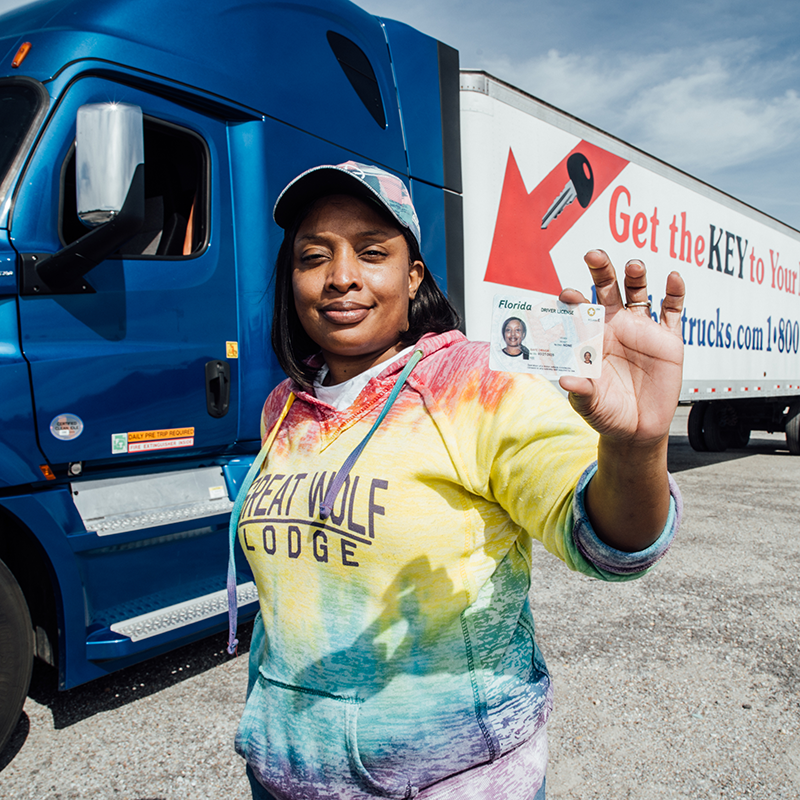
A proud truck driver stands in front of a blue semi-truck, holding up a driver's license.
*For Post 9/11 GI Bill® (Ch 33) students and VA Vocational Rehabilitation and Employment (Ch 31) students, our tuition policy complies with 38 USC 3679(e) which means Post 9/11 and Vocational Rehabilitation and Employment students will not be charged or otherwise penalized due to a delay in VA tuition and fee payments.  For eligibility consideration, a Post 9/11 GI Bill® student must submit a VA Certificate of Eligibility (COE) and a Vocational Rehabilitation Student must provide a VAF 28-1905 form. Students must provide school with a Certificate of Eligibility (COE) prior to beginning class, but not later than the first day of training. A print screen of Statement of Benefits page will be accepted in lieu of COE and verification of benefits will be required.  Please see 38 USC 3679(e) for complete details. GI Bill® is a registered trademark of the U.S. Department of Veterans Affairs (VA). More information about education benefits offered by VA is available at the official U.S. government website at www.benefits.va.gov/gibill