CDL Permit

If you dream of hitting the open road as a professional truck driver, you’ll first need to get a commercial learner’s permit (CLP) before you can obtain your commercial driver’s license (CDL). This legal document not only authorizes you to learn how to drive trucks, but also it’s your first step toward the chance to pursue a job with high earning potential and many career possibilities.

Ready to get started right away? One great thing about TDI is we’re a one-stop-shop: we include your commercial learner’s permit and DOT physical exam in your CDL training, and the cost of the DOT exam is accounted for in your tuition. That means less hassle, scheduling, and studying on your own—our experts will help walk you through everything from start to finish. Call us at (800) 848-7364 during business hours or fill out our contact form to speak with our staff about how to earn your CDL at TDI in just 15 days.

Let’s jump in the front seat and learn all about why you should get a CDL permit (or CLP), what the steps are for obtaining one, and how it can help you get your license as a professional trucker below.

What Is a CDL Permit?

A CDL permit gives you legal permission to learn how to drive trucks and buses with a licensed truck driver in the passenger seat. Also known as a commercial learner’s permit (CLP), a CDL permit is the national document required by the Federal Motor Carrier Safety Administration (FMCSA) for anyone who wants to learn how to operate trucks on public roads.

Benefits of Getting a Commercial Learner’s Permit (CLP)

Getting a commercial learner’s permit, or CDL permit, can open up many exciting roads for your career, skill set, and personal fulfillment. Here are just some of the advantages of getting your CLP:

  • Fulfill legal requirements: The FMCSA requires that all us truckers have a CDL permit before training behind the wheel on trucks or buses.
  • Learn about large vehicles: While some principles of driving a normal car are the same as driving a truck, there’s lots of specialized knowledge and practical skills specific to working in the trucking industry. Obtaining a CDL permit is the first step in developing this expertise.
  • Keep public roads safe: With a CDL permit, you increase your ability to keep yourself and others safe while you practice driving these heavy vehicles.
  • Boost your confidence: Having the proper tools and time to train on your journey to becoming a professional trucker can make you more confident in your abilities.
  • Career opportunities: Once your CLP has helped you obtain your CDL license, it’ll open up a world of career possibilities, including delivery, long haul, and, with the right endorsement, hazmat driver roles. Many of these jobs have high entry-level salaries and the potential to substantially increase your wages over time.
  • Job security: Since there’s a national shortage of truck drivers, there are often lots of roles available. This means that many truck drivers will have great job security for years to come.
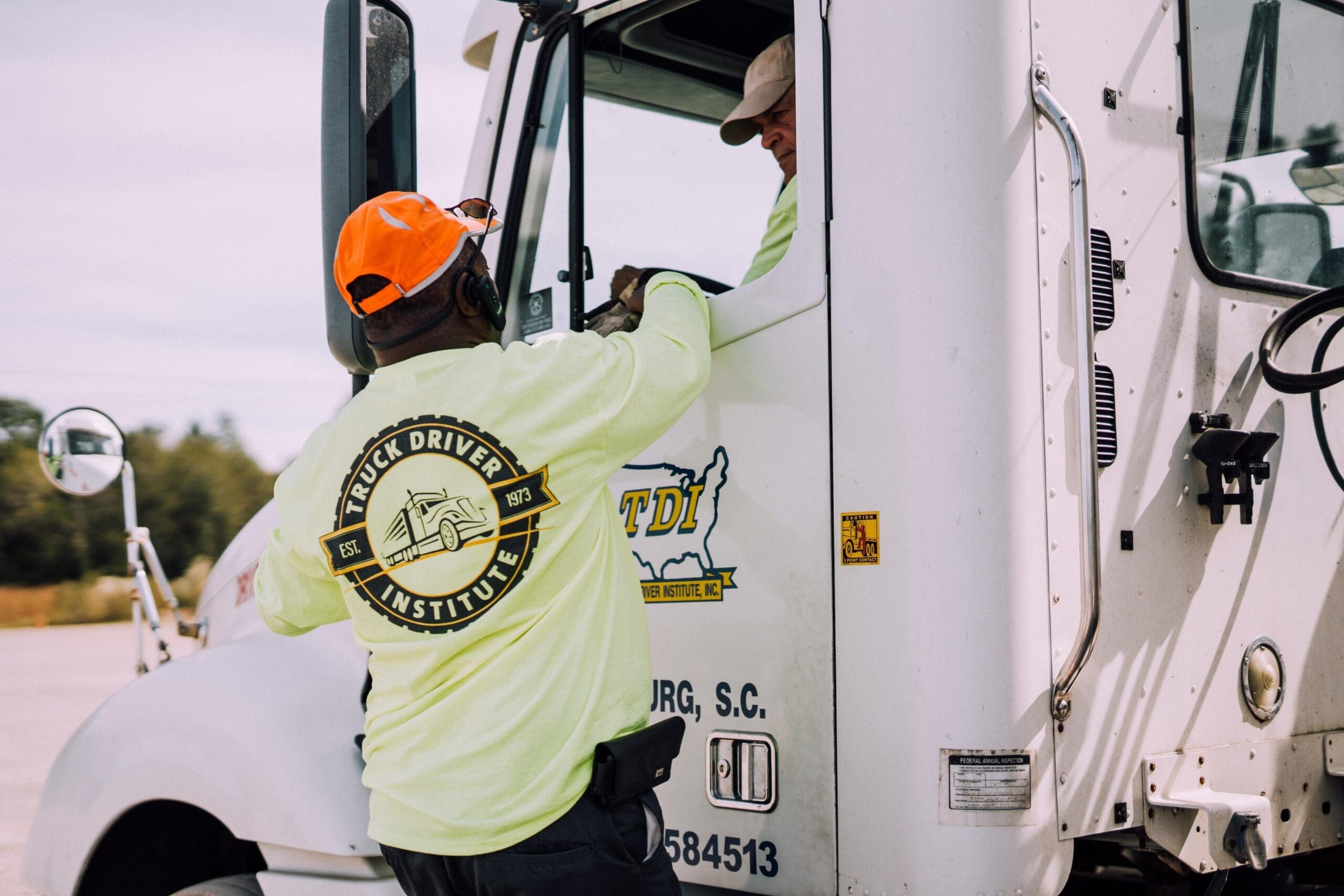
One truck driver talks to another through the window of his truck cab.

What Is Required to Get a CDL Permit?

Here’s what you’ll need to get your commercial learner’s permit:

1. Meet age requirements

In most states, you need to be at least 18 years old to obtain a CDL permit. Check with your state’s DMV about their eligibility laws related to commercial driving licenses.

2. Possess a non-commercial driver’s license

If you want to drive trucks professionally, you’ll first need to have a non-commercial driver’s license. This is the type of driver’s license that you already have if you can drive a personal vehicle. Having a non-commercial driver’s license shows the FMCSA and DMV that you understand the basics of vehicle operations, including keeping your car in good condition, braking, merging, and obeying traffic laws.

3. Have a good driving record

To get a CDL permit, you’ll need to have a decent driving record with your non-commercial driver’s license. That doesn’t mean your record necessarily needs to be perfectly spotless. The FMCSA wants to give commercial learner’s permits to those who have demonstrated they can safely share public roads with other drivers.

4. Undergo a DOT medical exam

Your DMV will ask to see your Department of Transportation (DOT) medical card when you apply for your CDL permit. You can only get a DOT medical card by taking a medical exam with a DOT certified examiner. The exam essentially evaluates if your physical and mental health will allow you to safely perform the many varied responsibilities involved with driving a truck, including seeing hazards at a distance, sitting for long periods of time, and hauling cargo.

5. Show proof of residency

You’ll need to be either a U.S. citizen or permanent resident to get a commercial learner’s permit. Be sure to bring your passport, green card, or other documents proving residency to the DMV when you apply for your CDL permit. If you aren’t a permanent resident but hope to become a professional trucker in the U.S., it’s best to speak to an immigration lawyer ahead of time about what steps you’ll need to take.

6. Pass a written exam

Before you can start training behind the wheel, you need to demonstrate your knowledge of driving commercial vehicles by passing a written exam. You can expect to be asked questions about general trucking knowledge (like driving and transporting cargo), the air brakes system on trucks, and how to safely drive and inspect tractor-trailers. You will need to answer at least 80% correctly to pass. Fortunately, at TDI we include this as part of your training, so you can study to pass your CLP exam with knowledgeable instructors who teach for a variety of learning styles.

7. Pay a fee

Finally, you’ll need to pay a fee to the DMV in order to get your CLP. The fee amount is usually in the range of $10 to $40. Your state’s DMV will be able to provide you with more specific information about the cost of your CDL permit.
How Do I Get My CDL License?

Once you’ve gotten your commercial learner’s permit (CLP), it’s time to hit the road to earn your license. Here’s what you’ll need to do get your CDL license:

  • Complete professional trucker training: The FMCSA requires that all aspiring truckers complete truck driving education with a registered training provider. At an expert truck driving school like TDI, you’ll develop both the knowledge and practical skills necessary to safely operate large vehicles and expand the horizons of your career.
  • Pass the written exam: The first part of the CDL license exam is a written test. This multiple choice exam will evaluate your knowledge of traffic laws, emergency procedures, and other vital topics.
  • Perform the driving test: You’ll also need to demonstrate that you know how to safely drive a truck during your CDL license exam. During this part of your exam, the DMV tester will ask you to perform truck driving skills such as braking, merging, and turning.

Why Choose TDI for Your CLP and CDL Training?

Most truck driving schools will ask you to get your CDL permit before enrolling. But if you choose TDI on your road to becoming a professional truck driver, we’ll include the training you need to succeed in getting your permit and license. Our instructors make sure you’re prepared with the knowledge you need to pass your commercial learner’s permit test and, down the road, your commercial driver’s license test, plus arrange to bring a doctor to campus during your training so you can get your DOT physical exam out of the way.

Here at TDI, we’re all about making the pavement as smooth as possible on your journey to become a trucker, and that includes your commercial learner’s permit. Discover now how to enroll or give us a call at (800) 848-7364 to start fueling up for your CLP and CDL.

*For Post 9/11 GI Bill® (Ch 33) students and VA Vocational Rehabilitation and Employment (Ch 31) students, our tuition policy complies with 38 USC 3679(e) which means Post 9/11 and Vocational Rehabilitation and Employment students will not be charged or otherwise penalized due to a delay in VA tuition and fee payments.  For eligibility consideration, a Post 9/11 GI Bill® student must submit a VA Certificate of Eligibility (COE) and a Vocational Rehabilitation Student must provide a VAF 28-1905 form. Students must provide school with a Certificate of Eligibility (COE) prior to beginning class, but not later than the first day of training. A print screen of Statement of Benefits page will be accepted in lieu of COE and verification of benefits will be required.  Please see 38 USC 3679(e) for complete details. GI Bill® is a registered trademark of the U.S. Department of Veterans Affairs (VA). More information about education benefits offered by VA is available at the official U.S. government website at www.benefits.va.gov/gibill